Scientific, not intimidating
Understanding QEEG in Pediatric Contexts
How brain mapping can support a broader understanding of the child without overwhelming parents, replacing diagnosis, or being presented as a shortcut.
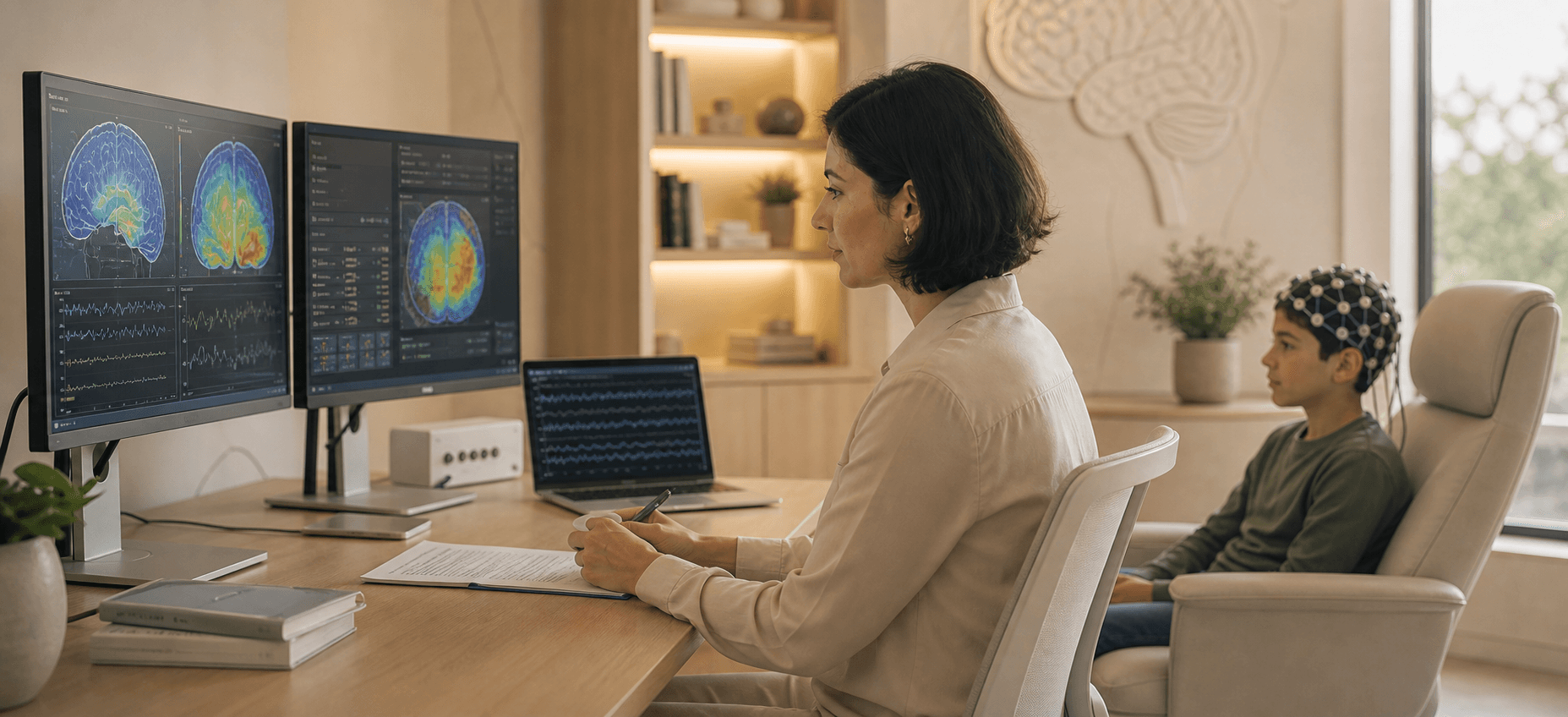
What QEEG is actually looking at
A quantitative EEG does not take a photograph of the brain. It analyzes patterns in electrical activity recorded from the scalp and compares some of those patterns with reference data. In clinical terms, that makes it a functional measure rather than a diagnosis.
Used carefully, it can help a team think about timing, arousal, reactivity, attention, or regulation in a more structured way. In pediatric care, that may support the sequencing of therapy or help document how the team is reasoning about a child’s starting point.
Its value is greatest when it is read alongside developmental history, examination findings, therapeutic observation, and family goals. Taken alone, it quickly becomes more impressive than useful.
Where it can help and where it should stay modest
The American Clinical Neurophysiology Society describes qEEG as an adjunctive tool in selected situations, not as a universal answer for every developmental or behavioral question. That wording matters. Adjunctive means it may contribute to the picture; it does not become the picture on its own.
For families, that distinction is often reassuring. A complementary tool can still be valuable. It can help guide the level of therapeutic intensity, identify domains that deserve closer observation, or provide another way of talking about change over time.
The problem starts when functional mapping is presented as a definitive explanation for a child’s identity, personality, or future. A serious center avoids that slide.
What it should not be used to claim
A good example of necessary caution comes from the American Academy of Neurology practice advisory on the EEG theta/beta power ratio in ADHD diagnosis. The advisory concluded that the measure should not be used to confirm an ADHD diagnosis or replace standard clinical evaluation.
That principle is broader than ADHD. When a center says that a map replaces developmental assessment, neurological evaluation, or diagnostic reasoning, families should slow down and ask harder questions.
QEEG can be informative. It becomes unsafe when it is marketed as certainty.
What a useful family explanation sounds like
A careful explanation usually sounds modest and specific. It might say: this pattern may fit with high reactivity, slower regulation, or uneven attention; we will compare it with clinical observation and use it to think about pacing, support, and follow-up.
Parents should leave with a translation they can actually use, not with a technical report that increases anxiety. In that sense, the explanation is part of the intervention. Calm interpretation protects families from both false reassurance and unnecessary fear.
Sources